Publications
Here is a list of my major publications. Press "Learn more +" to see the summary of each paper.
First-author papers
-
arXiv:2606.22266 · 2026
Fast targeted gravitational-wave followup search for compact binary mergers using GSTLAL pipeline
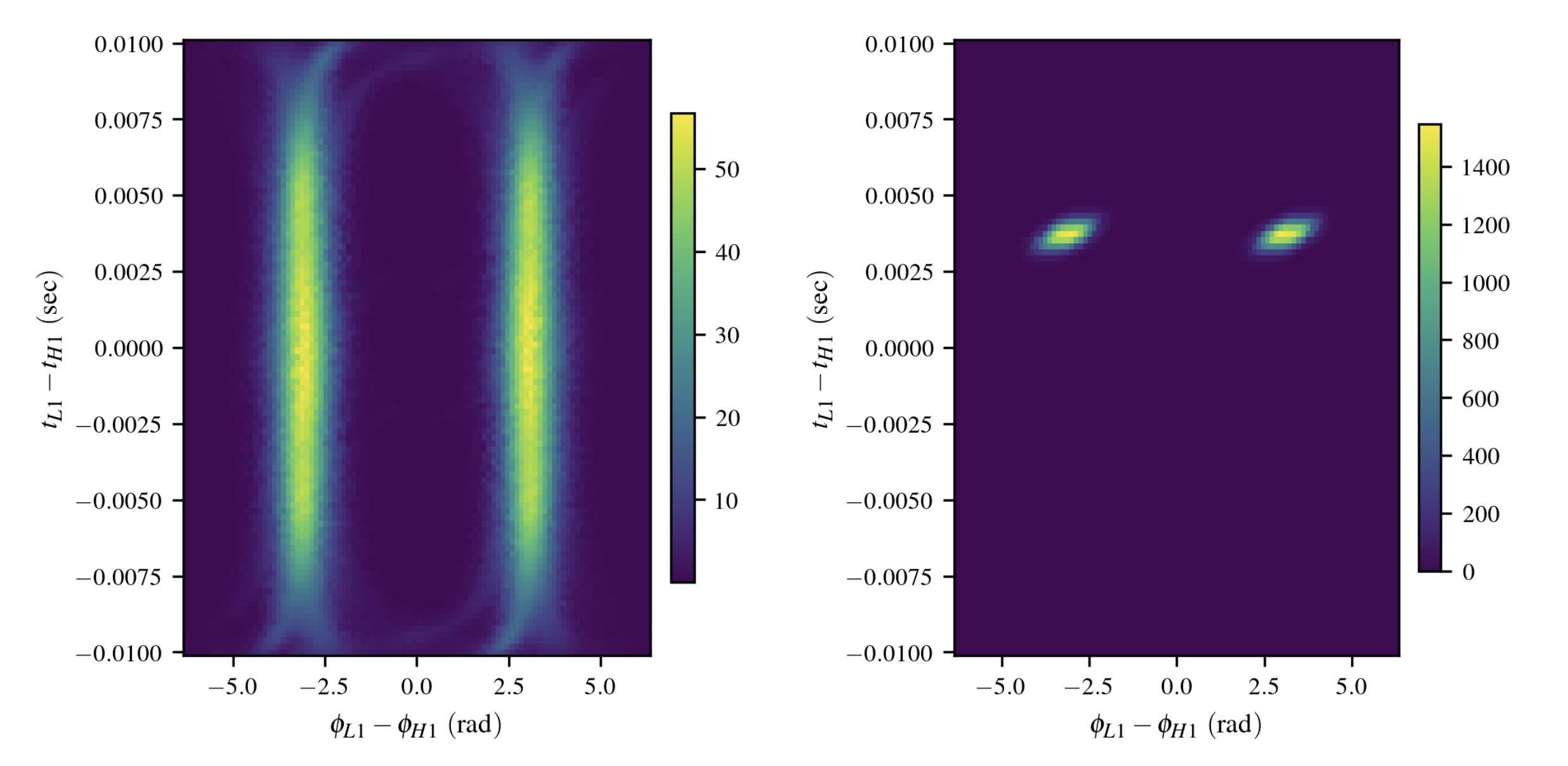
Coherence PDF for the LIGO Hanford and Livingston detector pair. Left : All-sky configuration used in the standard search. Right : Single-pixel configuration computed for a specific sky location. Introduction
Some of the most exciting gravitational-wave events also shine in light, such as the short gamma-ray burst that accompanied the neutron-star merger GW170817. When a satellite or telescope catches such a transient first, it tells us where on the sky and when to look. This paper asks how much more a gravitational-wave search can find by using that information directly, especially for faint signals that an all-sky search would miss.
What the paper finds
We built a targeted mode of the GstLAL pipeline that folds the sky localization and arrival time of an external trigger into its likelihood-ratio ranking statistic, focusing the analysis on the region of the sky the trigger points to. In injection studies, the targeted search detects signals consistent with the trigger's location and time more efficiently than the standard all-sky search, while keeping false alarms under control. The method is fast enough for rapid follow-up of electromagnetic transients.
-
Physical Review D 108, 124042 · 2023
Extension of the Bayesian searches for anisotropic stochastic gravitational-wave background with nontensorial polarizations
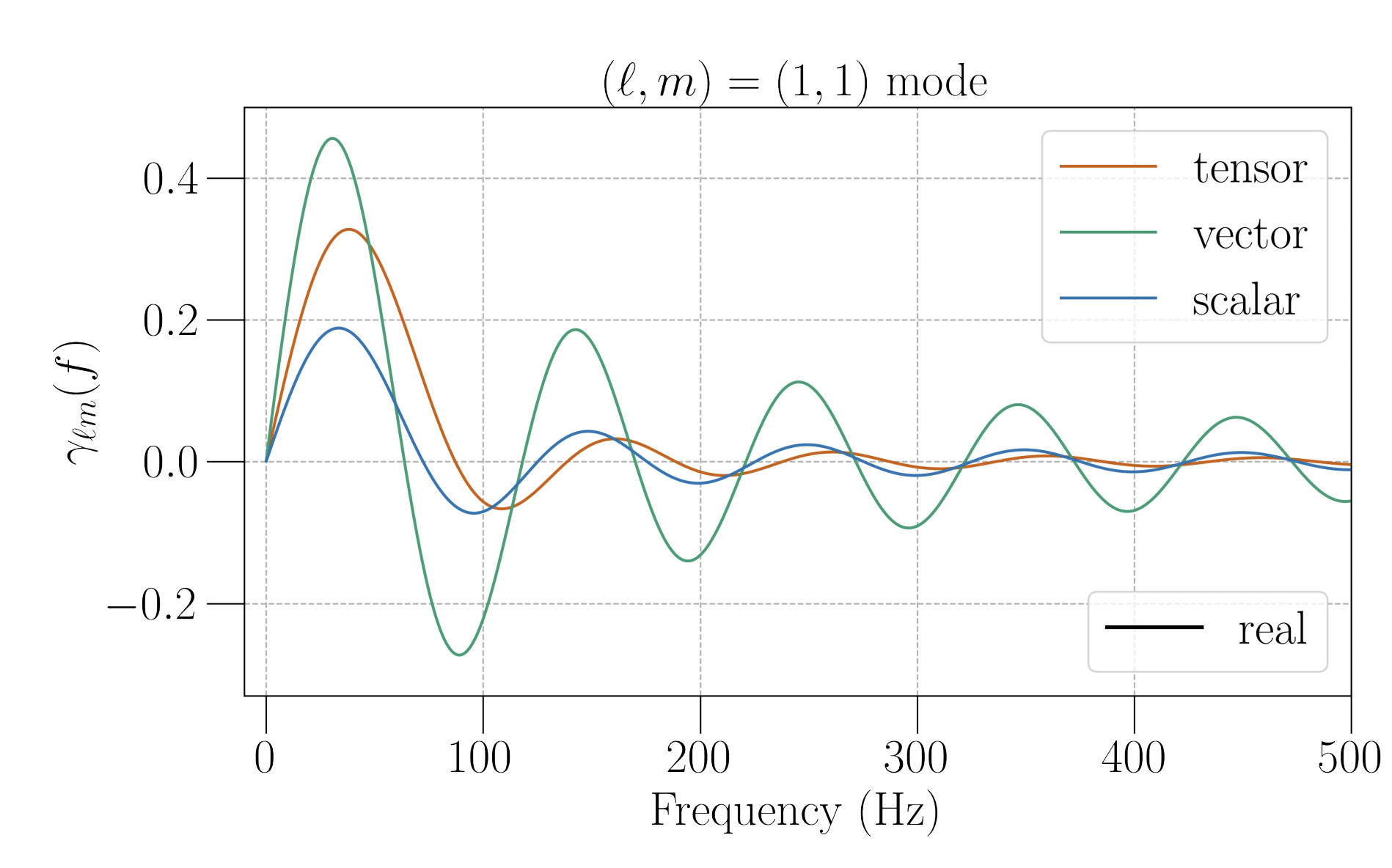
SPH-based overlap reduction function of the two LIGO detector pair for each polarization family over 0 Hz to 500 Hz for (ℓ, m) = (1, 1) mode. . Introduction
General relativity allows gravitational waves only two polarizations; alternative theories of gravity allow up to six. Earlier work searched LIGO's data for these extra polarizations in the stochastic gravitational-wave background, assuming the background is the same in every direction. But the background's pattern on the sky carries information about where it comes from, so this study extends that Bayesian search to anisotropic signals.
What the paper finds
In injection campaigns, adding anisotropic components to the signal model identified both the signal and violations of general relativity more significantly. The anisotropy also helps break degeneracies between polarization components, so model parameters are measured more precisely than with an isotropic analysis, while upper limits stay comparable when no signal is present. The results may depend on the assumed sky distribution, such as the Galactic plane, but they lay the groundwork for a single Bayesian analysis of a background's anisotropies and non-tensorial polarizations together.
-
Physical Review D 108, 043004 · 2023
Improved ranking statistics of the GstLAL inspiral search for compact binary coalescences
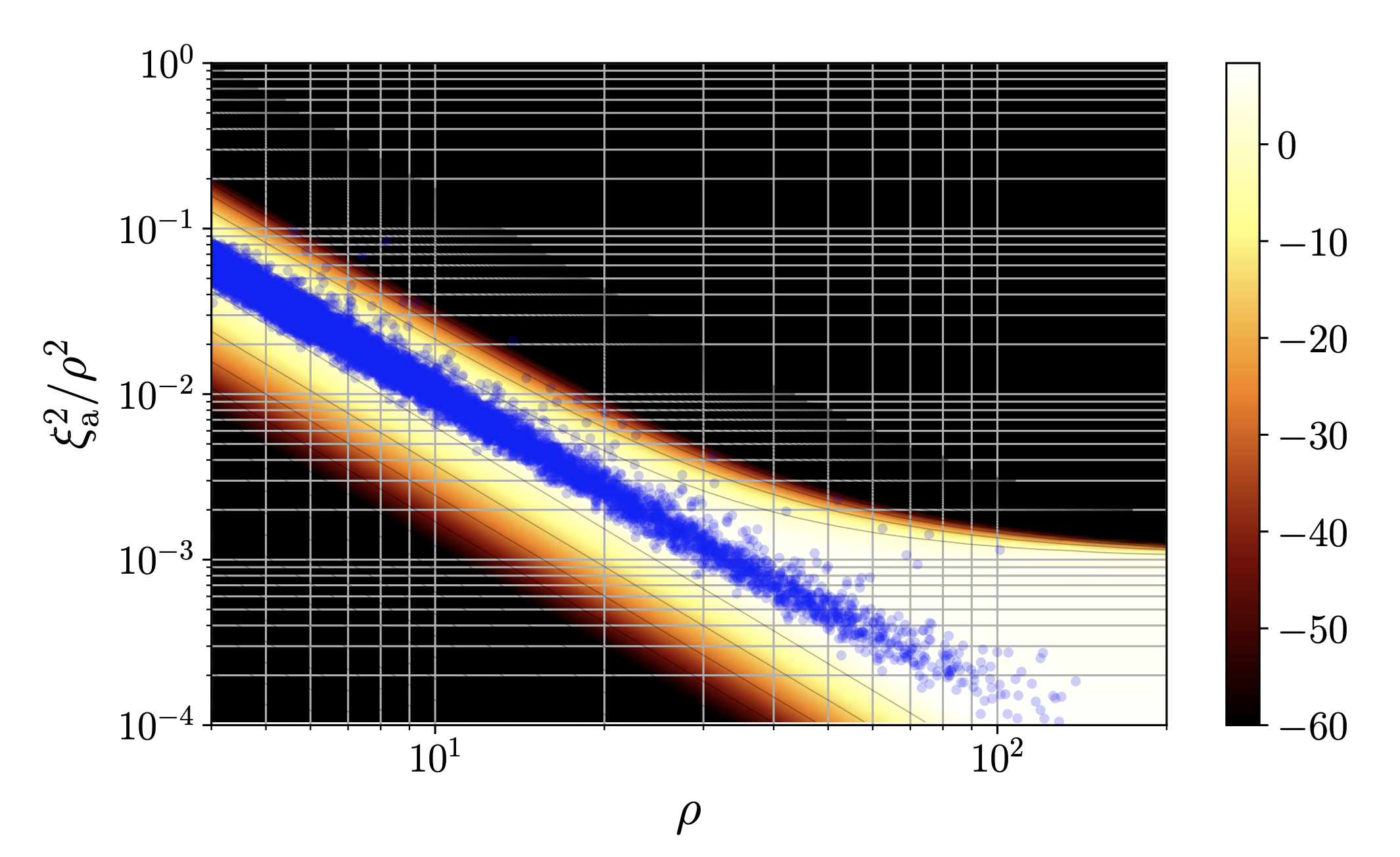
Scatter plot of recovered BNS injections, denoted by blue circles on top of the ρ–ξ2 signal model associated with BNS templates for LIGO Hanford detector. The color scheme encodes the probability density in a logarithmic scale with a brighter region having larger values. Introduction
Low-latency pipelines decide within seconds which candidate signals are worth alerting astronomers about, and the ranking statistic they use to weigh candidates against noise sets how many real signals they catch. Ahead of the fourth observing run (O4), with more sensitive detectors and KAGRA joining the network, this paper upgrades the ranking statistic of the GstLAL inspiral pipeline.
What the paper finds
Four new features: removing signal contamination from the background model, adding the bank-ξ2 signal-consistency statistic, an upgraded ρ–ξ2 signal model, and integrating the KAGRA detector. An injection study shows that together they improve the pipeline's sensitivity by roughly 15–20%, preparing it for multi-messenger observations in O4.
-
Physical Review D 107, 023024 · 2023
Bayesian parameter estimation for targeted anisotropic gravitational-wave background
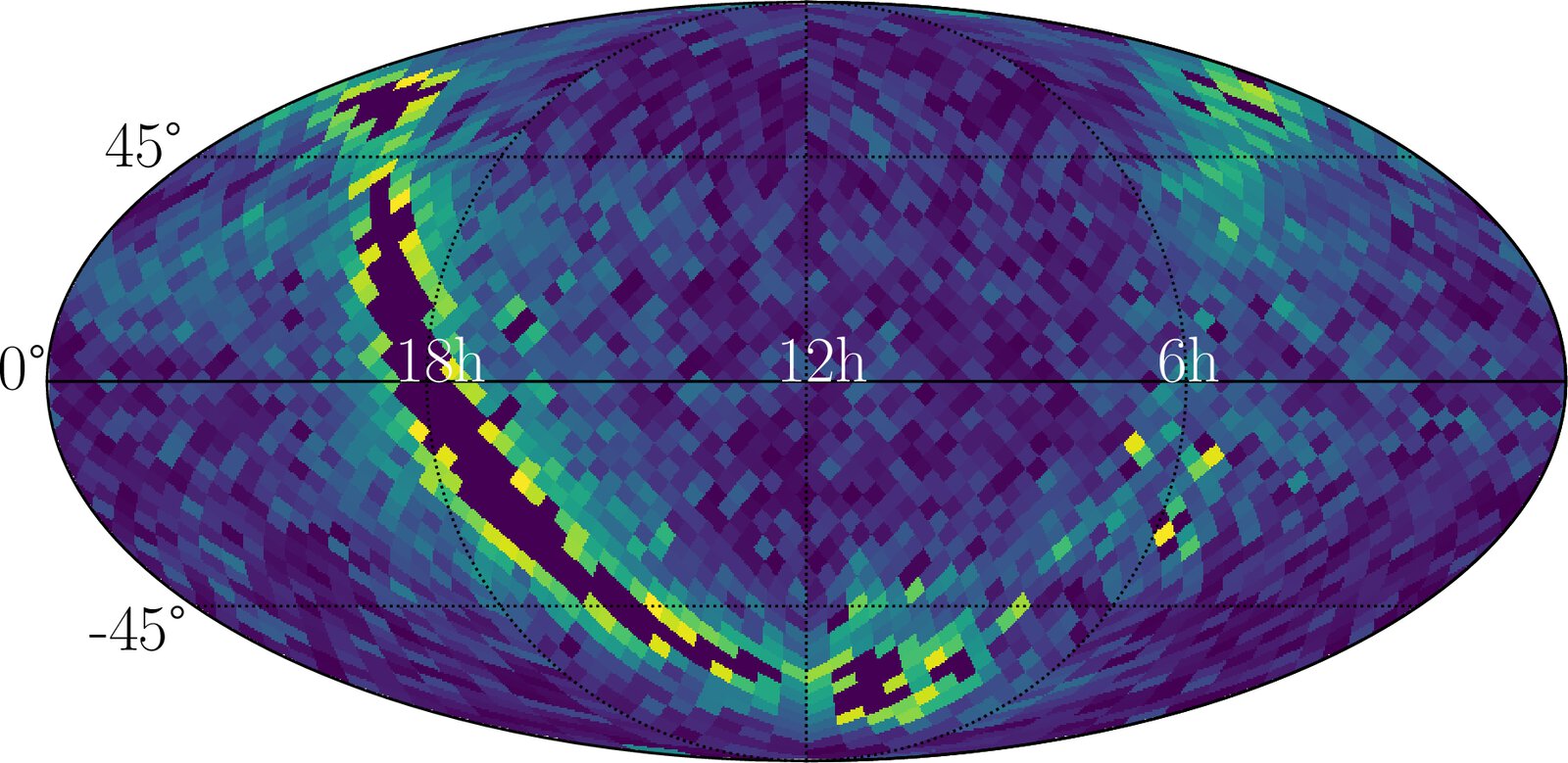
A mock Galactic-plane distribution of background energy density across the sky, used to test the Bayesian search. Introduction
Extended populations of sources, such as the millisecond pulsars in our Galaxy, would produce a stochastic gravitational-wave background whose strength varies across the sky. Earlier LIGO–Virgo analyses constrained this anisotropy through its angular power spectrum in a spherical-harmonic basis, but that approach cannot estimate the parameters of a physical model of the sources.
What the paper finds
This paper introduces a Bayesian method that searches for a background with a specific pattern on the sky. It gives posteriors on model parameters and lets different signal models be compared. Instead of fixing the finest angular scale in advance, it chooses that cut-off from a Bayes factor that depends on the signal's amplitude and angular scale. Applied to data from LIGO and Virgo's third observing run for a millisecond-pulsar population, it constrains the signal amplitude to ε < 2.7 × 10⁻⁸ at 95% confidence.
-
Physical Review D 103, 083005 · 2021
Modeling and searching for a stochastic gravitational-wave background from ultralight vector bosons
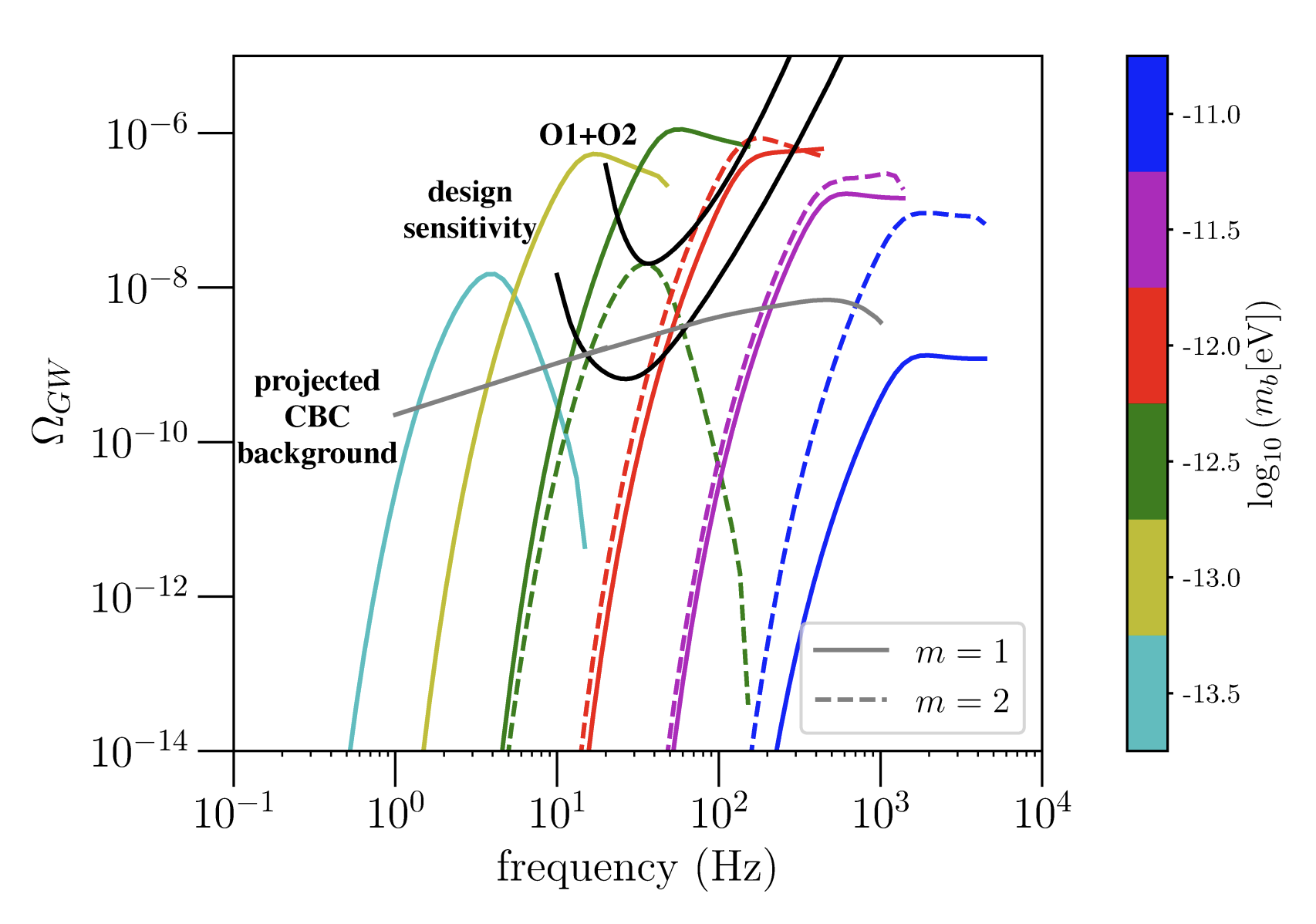
Energy spectrum density of SGWB from ultralight vector with different masses compared against different LIGO sensitivity curves Introduction
Ultralight bosons, dark-matter candidates in many theories beyond the Standard Model, can draw energy from spinning black holes through superradiance. They build up clouds that radiate nearly monochromatic gravitational waves, and summed over all black holes in the Universe these form a stochastic background. This paper studies massive vector bosons, which can produce a much stronger signal than scalar ones.
What the paper finds
Using recent numerical results for the gravitational-wave emission, and black-hole populations that include both isolated black holes and binary merger remnants, we computed the expected background and searched for it in data from Advanced LIGO's first and second observing runs. No signal was found. If isolated black-hole spins are optimistically uniform between 0 and 1, vector bosons with masses from 0.8 × 10⁻¹³ to 6.0 × 10⁻¹³ eV are excluded at 95% credibility. With more pessimistic spins, a narrower range around 10−13 eV is still excluded, as long as spins reach above about 0.2.
-
Physical Review D 99, 103015 · 2019
First search for a stochastic gravitational-wave background from ultralight bosons
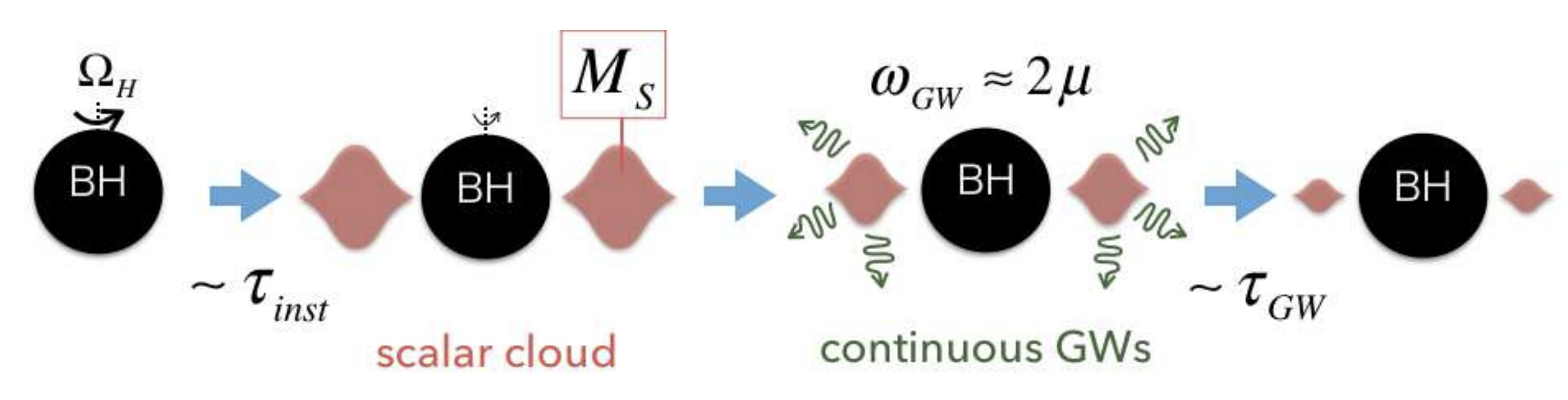
A boson cloud grows around a spinning black hole through superradiance, then dissipates by emitting gravitational waves. Introduction
If ultralight bosons exist, clouds of them around spinning black holes would emit gravitational waves, and together these clouds would create a stochastic background. Building on the model of Brito et al. (2017), this paper turns that prediction into the first search for such a background in LIGO and Virgo data.
What the paper finds
We developed a Bayesian analysis, added black holes born in binary mergers to the source population, worked out which boson masses Advanced LIGO and Virgo could constrain at design sensitivity, and tested whether a boson background can be told apart from the one made by distant compact-binary mergers. A search of data from Advanced LIGO's first observing run found no evidence of a signal. Because the boson mass is degenerate with uncertain astrophysics such as black-hole spins, no mass can be robustly excluded; under optimistic assumptions, masses from 2.0 × 10⁻¹³ to 3.8 × 10⁻¹³ eV are excluded at 95% credibility.
-
Physical Review D 97, 103009 · 2018
Application of a Zero-latency Whitening Filter to Compact Binary Coalescence Gravitational-wave Searches
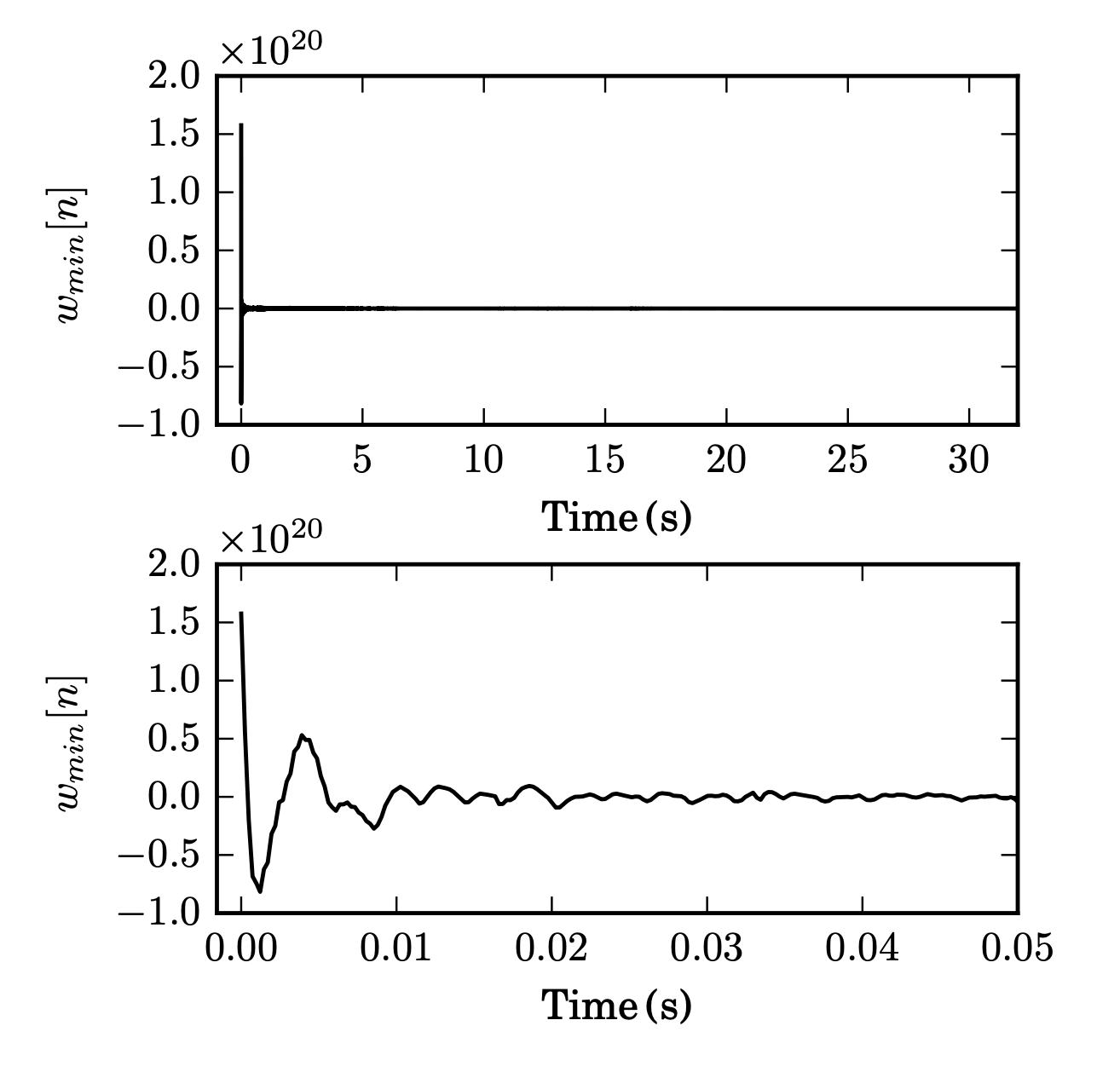
The impulse response of the zero-latency whitening filter. This FIR filter is purely causal. Introduction
Light from a neutron-star merger can fade quickly, so telescopes need gravitational-wave alerts as soon as possible. One of the main sources of delay in detection pipelines is whitening the data, which uses a phase-preserving filter that adds latency. This paper tests whether a zero-latency whitening filter can replace it without hurting detection.
What the paper finds
In a compact-binary detection pipeline, the zero-latency filter reproduces signal-to-noise ratios consistent with the original high-latency filter, for both detector noise and simulated signals (injections). The two filters also agree closely in the χ2 signal-consistency test used to separate real signals from noise, so whitening no longer has to hold up detection.
Co-authored papers 33 Show allHide
-
arXiv:2606.10076 · 2026
Method to get Better Sky Maps in a GstLAL Low-Latency Analysis
-
arXiv:2605.19153 · 2026
GstLAL O4 Online Results Paper
-
Physical Review D 114, 102001 · 2026
Gauge theoretic signal processing. II. Zero-latency whitening for early warning pipelines
-
arXiv:2602.21615 · 2026
GW070605: An Undisclosed Binary Neutron Star Hardware Injection in LIGO's Fifth Science Run
-
arXiv:2511.04730 · 2025
SGNL: Scalable Low-Latency Gravitational Wave Detection Pipeline for Compact Binary Mergers
-
arXiv:2509.09741 · 2025
GW231109_235456: A Sub-threshold Binary Neutron Star Merger in the LIGO-Virgo-KAGRA O4a Observing Run?
-
arXiv:2506.06497 · 2025
New Methods for Offline GstLAL Analyses
-
arXiv:2505.23959 · 2025
How Many Times Should We Matched Filter Gravitational Wave Data? A Comparison of GstLAL's Online and Offline Performance
-
Physical Review D 112, 044013 · 2025
Template bank for subsolar mass compact binary mergers in the fourth observing run of Advanced LIGO, Advanced Virgo, and KAGRA
-
Physical Review D 112, 124011 · 2025
Applicability of multicomponent study on Bayesian searches for targeted anisotropic stochastic gravitational-wave background
-
Physical Review D 112, 082002 · 2025
Scalable matched-filtering pipeline for gravitational-wave searches of compact binary mergers
-
Physical Review Letters 133, 201401 · 2024
Searching for Asymmetric and Heavily Precessing Binary Black Holes in the Gravitational Wave Data from the LIGO Third Observing Run
-
Physical Review D 110, 023038 · 2024
Searching for gravitational-wave signals from precessing black hole binaries with the GstLAL pipeline
-
Journal of Open Source Software 9, 5454 · 2024
pygwb: a Python-based library for gravitational-wave background searches
-
Physical Review D 109, 042008 · 2024
Performance of the low-latency GstLAL inspiral search towards LIGO, Virgo, and KAGRA’s fourth observing run
-
Physical Review D 109, 044066 · 2024
Template bank for compact binary mergers in the fourth observing run of Advanced LIGO, Advanced Virgo, and KAGRA
-
Physical Review D 108, 123040 · 2023
Rapid localization and inference on compact binary coalescences with the Advanced LIGO-Virgo-KAGRA gravitational-wave detector network
-
arXiv:2306.07190 · 2023
When to Point Your Telescopes: Gravitational Wave Trigger Classification for Real-Time Multi-Messenger Followup Observations
-
Physical Review D 108, 084032 · 2023
Method for removing signal contamination during significance estimation of a GstLAL analysis
-
Physical Review D 108, 083043 · 2023
Unified pastro for gravitational waves: Consistently combining information from multiple search pipelines
-
The Astrophysical Journal 952, 25 · 2023
pygwb: A Python-based Library for Gravitational-wave Background Searches
-
Physical Review D 108, 042003 · 2023
Binary tree approach to template placement for searches for gravitational waves from compact binary mergers
-
Physical Review D 106, 023010 · 2022
Angular resolution of the search for anisotropic stochastic gravitational-wave background with terrestrial gravitational-wave detectors
-
Physical Review D 106, 084033 · 2022
Metric assisted stochastic sampling search for gravitational waves from binary black hole mergers
-
Physical Review D 103, 043011 · 2021
High speed source localization in searches for gravitational waves from compact object collisions
-
Physical Review D 103, 084047 · 2021
Template bank for spinning compact binary mergers in the second observation run of Advanced LIGO and the first observation run of Advanced Virgo
-
arXiv:2011.02457 · 2020
Automating the Inclusion of Subthreshold Signal-to-Noise Ratios for Rapid Gravitational-Wave Localization
-
arXiv:2010.15282 · 2020
Incorporation of Statistical Data Quality Information into the GstLAL Search Analysis
-
arXiv:2010.05082 · 2020
GstLAL: A software framework for gravitational wave discovery
-
arXiv:2009.03025 · 2020
Improving the background estimation technique in the GstLAL inspiral pipeline with the time-reversed template bank
-
The Astrophysical Journal Letters 905, L25 · 2020
An Early-warning System for Electromagnetic Follow-up of Gravitational-wave Events
-
Physical Review D 101, 022003 · 2020
Fast evaluation of multidetector consistency for real-time gravitational wave searches
-
arXiv:1901.08580 · 2019
The GstLAL Search Analysis Methods for Compact Binary Mergers in Advanced LIGO's Second and Advanced Virgo's First Observing Runs
Collaboration papers (major contribution) 6 Show allHide
-
Physical Review Letters 137, 071401 · 2026
GW240925 and GW250207: Astrophysical Calibration of Gravitational Wave Detectors
My contribution
Part of the paper writing/analysis team, being responsible for GW searches.
-
arXiv:2605.27225 · 2026
GWTC-5.0: Observations from the Second Part of the Fourth LIGO-Virgo-KAGRA Observing Run and Updates to the Gravitational-Wave Transient Catalog
My contribution
Editorial chair, leading all the editorial/publication activities.
-
Physical Review D 114, 022001 · 2026
Directional search for persistent gravitational waves: Results from the first part of LIGO-Virgo-KAGRA's fourth observing run
My contribution
Editorial co-chair
-
The Astrophysical Journal Letters 1004, L22 · 2026
GWTC-4.0: Updating the Gravitational-Wave Transient Catalog with Observations from the First Part of the Fourth LIGO-Virgo-KAGRA Observing Run
My contribution
Editorial reviewer, catalog data management.
-
Physical Review D 104, 022005 · 2021
Search for anisotropic gravitational-wave backgrounds using data from Advanced LIGO and Advanced Virgo's first three observing runs
My contribution
Part of paper writing/analysis team, responsible for spherical-harmonic analysis.
-
The Astrophysical Journal Letters 915, L5 · 2021
Observation of Gravitational Waves from Two Neutron Star–Black Hole Coalescences
My contribution
Part of paper writing/analysis team, being responsible GW searches.
Complete list, including LIGO–Virgo–KAGRA collaboration papers, on INSPIRE